


Online Training on Multidisciplinary Team Training on Women and Children Protection
Online Training on Multidisciplinary Team Training on Women and Children Protection

ONLINE TRAINING ON MULTIDISCIPLINARY TEAM TRAINING FOR WOMEN AND CHILDREN PROTECTION
RATIONALE
The Child Protection Network Foundation (CPN), Incorporated is a non-government organization founded in 2002. It is especially dedicated to compassionately and competently serve all abused children not only in the Philippines but also in the whole of Asia, so they get the chance to be developed to the best of their potentials within a nurturing family environment (https://www.childprotectionnetwork.org/about-us/ accessed on 9 April 2021). In 2013, by virtue of Administrative Order 2013-0011 signed by the Secretary of the Department of Health, CPN has been designated as a primary partner responsible for the establishment and maintenance of quality of services of all Women and Children Protection Units (WCPUs). Although especially created to protect children from abuse, CPN works in the broader context of domestic violence including the protection of women.
As of February 2021, the Philippine population is estimated at 100,981,437. From this total, 49,909,341 are female representing 49.42 percent. In terms of age groups, 10,818,931 or 10.71 percent belong to 0-4 years old; 32,155,793 or 31.84 percent are 0-14 years old, and 62,615,419 or 62.08 percent are from 18 years old and older. The figures show that more than 38 percent of the Philippine total population are children (Philippine Statistics Authority [PSA] at https://psa.gov.ph/statistics/quickstat/national-quickstat/all/* accessed on 9 April 2021). The Philippine Commission on Women cited PSA that one in four Filipino women age 15-49 years old has experienced physical, emotional, or sexual violence by their husband or partner (https://pcw.gov.ph/violence-against-women/). In its latest national survey of Filipino children, the United Nations Children Educational Fund (UNICEF) reported the high overall prevalence of violence against Filipino children with three out of five children being physically and psychologically abused, bullied, and almost one in five children being sexually violated (UNICEF, 2016). With the passing of Republic Act (RA) 7610: the “Special Protection of Children Against Abuse, Exploitation and Discrimination Act” of 1992 and RA 9262: “Anti-Violence Against Women and Their Children Act of 2004,” the campaign against women and children abuse became the centerpiece programs of the CPN.
When COVID-19 struck in March 2020, alarming reports revealed that “one of the most insidious consequences of the pandemic is the rise of gender-based violence (Gonzales, 2020). The Alliance of Child Protection in Humanitarian Action (2019) reported that the pandemic can disrupt the social and physical environments of children that may adversely affect their normal growth and development. With the closure of schools and other social institutions due to restrictions in physical distancing, children can feel isolated, experience neglect as their parents need to continue working even from home, and they become more vulnerable to abuse and other forms of domestic violence. The Alliance’s Technical Note: Protection of Children during the Coronavirus Pandemic, Version 1 (2019) called on whole-of-society, whole-of-government, and people-centered approach to capacitate social institutions in looking after the best interest of the children at the time of the pandemic (Technical Note: Protection of Children during the Coronavirus Pandemic (v.1) accessed on 24 June 2021).
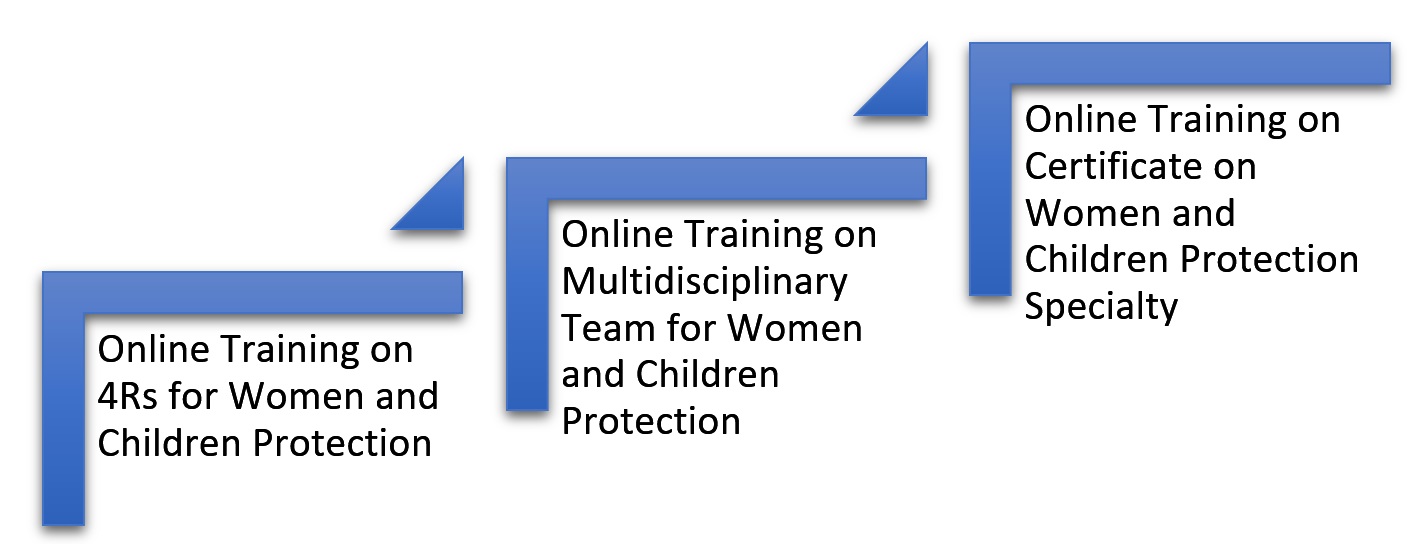
Central to all the operations of CPN for women and children protection is the capacitating of all members of society to recognize, record, report, and refer (4Rs) abused children and women. CPN has been conducting the 4Rs training for parents, school teachers, police officers, counsellors, physicians, social workers, lawyers, and other interested parties since 2008. This program evolved as the first step in the current ladderized program in women and children protection work. The other programs in the next ladders are the training in Multi-Disciplinary Team (MDT) approach, and the Certificate in Women and Children Protection Specialty (CWCPS). All these programs used to be a offered in a face-to-face (F2F) platform and participants coming from all groups were trained as a team. As COVID-19 continues to linger around the globe, CPN responds by migrating its ladderized program to an online platform.
TARGET PARTICIPANTS
Participants who satisfactorily complete the 4Rs, whose professional career tracks are related to management of domestic violence, and willing to pursue further educational qualifications may apply for the Online Multi-Disciplinary Team (MDT) Training. They may also seek the recommendation of their respective institutions to CPN for enrollment. Licensed professionals like physicians, social workers, guidance counsellors, and officers of the Philippine National Police (PNP) who complete the MDT Training will be awarded Certificates of Completion that they can present to the Continuing Professional Development (CPD) councils of the Professional Regulation Commission (PRC).
PROGRAM STRUCTURE
The ladder-type training programs of CPN are presented in the figure below. The 4Rs is a pre-requisite of the MDT which then serves as the gate pass to the WCPS. Participants can be enrolled as a participant upon formal application to CPN or receipt of their organization’s recommendation. They can complete the 4Rs at their convenient time.
PROGRAM OUTCOMES OF THE ONLINE TRAINING ON MULTDISCIPLINARY TEAM FOR WOMEN AND CHILDREN PROTECTION
The MDT is especially designed for medical practitioners, social workers, and PNP officers whose career paths focus on women and children protection work. This is composed of four online modules for women and children protection unit (WCPU) practitioners and program managers. The modules are also ladderized such that the first serves as prerequisite to the next until the completion of all the four.
Licensed professionals like physicians, social workers, guidance counsellors, and officers of the Philippine National Police who have completed MDT Training are expected to:
- Demonstrate effective communication skills
- Gather evidence competently to establish abuse
- Appropriately use the MDT approach in VAWC cases
- Perform case management effectively
MDT MODULE 1: THE MULTI DISCIPLINARY TEAM (MDT) APPROACH
In this module, the overall dynamics of victimizing women and children will be contextualized and will be addressed using the basic principles and applications of MDT. As the introductory session of MDT, Module 1 will begin with the first synchronous session and assemble the three groups of professionals and their specific roles as a multidisciplinary team will be described.
MDT Module 1 will be composed of the following module videos (MVs):
- MDT – M1V1: General Legal Framework of Woman and Child Abuse
- References for MDT – M1V1 (HTML): Republic Act 7610
- References for MDT – M1V1 (HTML): Republic Act 9262
- MDT – M1V2: Multidisciplinary Team Approach in Managing VAWC
- References for MDT – M1V2 (PDF): DOH AO 2013-0011_Revised policy on WCPUs in Government hospitals
- References for MDT – M1V2 (PDF): WHO endingn VAC try health stregthening multisectoral approaches
- References for MDT – M1V2 (PDF): WHO Violence Prevention tru Mutlisectoral Collaboration
- MDT – M1V3: Long Term Effects of Child Maltreatment
- MDT – M1V3 Online Educational Resources (PDF): Green, Haisley, et al., 2020
- MDT – M1V3 Online Educational Resources(PDF): Moffit and Klaus-Grawe, 2012
- MDT – M1V3 Online Educational Resources(PDF): Ramiro, Madrid, Brown, 2010
- MDT – M1V3 Online Educational Resources(PDF): Strathearn, GIanotti, et al., 2020
- MDT – M1V3 Online Educational Resources(DOCX): The Developing Brain
- MDT – M1V3 Online Educational Resources(PDF): Zeanah and Humpreys, 2018
- MDT – M1V4: Recognizing Abuse in Women
- References for MDT – M1V4 (PDF): Cycle of Violence
- References for MDT – M1V4 (PDF): Intimate Partner Violence
- MDT – M1V5: Recognizing Sexual Abuse in Children and Women
- Required and Supplemental Learning Materials for MDT – M1V5 (Web Page): Definition of Sexual Violence Against Women (supplemental)
- Required and Supplemental Learning Materials for MDT – M1V5 (Video): Video on Consent
- Required and Supplemental Learning Materials for MDT – M1V5 (PDF): A-Guide-for-Young-People-on-Sexual-Assault
- Required and Supplemental Learning Materials for MDT – M1V5 (PDF): Case of Eloisa
- Required and Supplemental Learning Materials for MDT – M1V5 (PDF): Case of Tres Marias
- Required and Supplemental Learning Materials for MDT – M1V5 (PDF): Responding to Children and Adolescents who have been sexually abused
- MDT – M1V6: Recognizing Physical Abuse in Children
- Case Report on Khylie
- Video of Case Report of People of the Philippines versus Marivic Genosa
MDT MODULE 2: DOMESTIC VIOLENCE AS A LEGAL, MEDICAL, AND SOCIAL PANDEMIC
After understanding and appreciating the magnitude of women and children abuse in the Philippines, the role of the professionals dealing with the problem must be clarified and explicitly analyzed. MDT Module 2 deals with women and children abuse as both a medical and legal pandemic. Sessions include the immediate first aid when the abuse has been established, its intergenerational consequences, and what the legal system of the country can do to take the victims out from abuse.
MDT Module 2 will be composed of the following module videos (MVs):
- MDT – M2V1: Crisis Intervention and Psychological First Aid
- MDT – M2V2: Dynamics of Victimization
- M2Q1 – The Case of Crystal
- Required references (PDF): A global review of the intersections of VAW VAC
- Required references (PDF): Big Boys Dont Cry
- Required references (PDF): Childrens Exposure to IPV an overview
- Supplemental references (PDF): IPV and CM in a Brazilian cohort study co-occurence risk factors
- Supplemental references (PDF): Pathways between chilhd trauma, IPV parenting
- Supplemental references (PDF): Predicting Sexual Revictimization in Childhd Adol
- Supplemental references (PDF): Prevalence of revictimization
- Supplemental references (PDF): Systematic literature review of drivers of violence affecting children
- MDT – M2V3: Limits of Medico-legal Examination
- MDT – M2V4: Multidisciplinary Evaluation and Management of Child Abuse Cases
- MDT – M2V5: Multidisciplinary Case Conference on Child Abuse
- MDT – M2V5: Sample video on How to Conduct a Case Conference
- The Legal Case of Rosa
- The Legal Case of Basti
- MDT – M2V6: Testifying in Court
- MDT – Module 2 Online Educational Resources
- Video: CPU 10th founding anniversary at
- Video: Case conference discussed during the Ako Para sa Bata conference at
MDT MODULE 3: PROFESSIONAL SKILLS OF MDT PRACTITIONERS AND MANAGERS
MDT Module 3 provides the team members a variety of teaching and learning opportunities to acquire and enhance their professional skills in addressing domestic violence through the multi-disciplinary approach. Satisfactory finishers of MDT Module 2 will be automatically promoted to complete this module. Participants will again be introduced to this module through a synchronous meeting.
MDT Module 3 will be composed of the following module videos:
- Module Videos during the Synchronous Meeting
- MDT – M3V1: Developmentally Appropriate Interview of an Abused Child
- MDT – M3V1: Sample Video of Interviewing a Woman Victim of Domestic Violence
- MDT – M3V1: Sample Video of Interviewing a Child
- MDT – M3V2: Gender Responsive Case Management of Abused Women
- References – M3V2 (Link): G.R. No. 135981 September 29, 2000 – PEOPLE OF THE PHIL. v. MARIVIC GENOSA
- References – M3V2 (Link): People of the Philippines v. Marivic Genosa, G.R. No. 135981 (2004)
- References – M3V2 (PDF): Gender Responsive Case Management in Abused Women Supplemental Reading
- References – M3V2 (PDF): VAW Clinical Handbook
- MDT – M3V3: Safety Assessment for Children
- Module 3: Videos for Physicians (Asynchronous)
- MDT – M3V4: History Taking
- References – M3V4 (PDF): History Taking_Required Reading
- MDT – M3V4: History Taking
-
- MDT – M3V5: Physical Examination of Children and Women
- References – M3V5 (PDF): Evaluation of children in primary care setting when sexual abuse is suspected
- References – M3V5 (PDF): Medicolegal Terminology and Interpretation of Medical Findings
- References – M3V5 (PDF): Guidelines on the Medicolegal Care of Victims of Sexual Violence
- MDT – M3V5: Physical Examination of Children and Women
-
- MDT – M3V6: Anogenital Examination
- MDT – M3V7: Charting and the Medico-Legal Form
- MDT – M3V8: Medical Management: Diagnostics and Treatment
- References – M3V8 (PDF): HIV and STI prophylaxis guidelines for WCPU
- Module 3: Videos for the VAWC Desk Police Officer (Asynchronous)
- MDT – M3V9: How to Prepare a Sworn Statementli>
- References – M3V9: Manual_On_Taking_the_Sworn_Statement
- MDT – M3V10: Crime Scene Investigation
- MDT – M3V11: Search Warrants and Warrants of Arrest
- MDT – M3V9: How to Prepare a Sworn Statementli>
- Module 3: Videos for Social Workers (Asynchronous)
- MDT – M3V12: Risk Assessment for Children
- MDT – M3V13: Risk Assessment Situationer
- MDT – M3V14: Social Case Study Report
- Module 3: Videos for Nurses (Asynchronous)
- MDT – M3V15: Triage
- MDT – M3V16A: Preparing a Child For Medical Examination
- MDT – M3V16B: Preparing Children For A Medical Examination
- MDT – M3V17: Discharge Instructions
- Exercise on Charting
- Instructions and Forms for the Asynchronous Exercise on Charting
- Document: CPU_Immediate Safety Assessment
- Document: CPU_Intake Form.docCPU_Intake Form
- Document: CPU_Interview Form.docCPU_Interview Form
- Document: Instructions to Asynchronous Exercise on Charting.docxInstructions to Asynchronous Exercise on Charting
- Exercise on Charting (Case of Eloisa)
- Exercise on Charting (Case of Tessa of Tres Marias)
- Exercise on Charting (Case of Rosa)
- Instructions and Forms for the Asynchronous Exercise on Charting
MDT MODULE 4: THE MULTIDISCIPLINARY CASE CONFERENCE
This module serves as the Practicum of MDT Training. Participants will be oriented on the basic procedures in the conduct of an effective multidisciplinary case conference involving not only themselves as a team but also the victims, their support persons, family members, and other relevant individuals. Upon completion of MDT M3, participants will be given instructions to work in teams asynchronously to finalize their Case Conference Plan and carry it out in a pre-recorded online role playing. The role plays of all groups will be presented during the final synchronous meeting followed by the Closing Ceremony.
Requirements
The MDT is specially designed for medical practitioners, social workers, and PNP officers whose career paths focus on women and children protection work. This is composed of synchronous and asynchronous online modules for women and children protection unit (WCPU) practitioners and program managers.
- The team shall comprise of at least one (1) physician and one (1) social worker from the same institution.
- The team must have completed the Online Training on the 4Rs for Women and Children Protection (Level 1 training).
- Trainees are recommended by their respective organizations and supervisors, and they are expected to be given officially protected time to work on the modules.
- Upon completion of the Online MDT Training, the Hospital management shall allow the team to establish a VAWC Desk, and the team shall be assigned to manage and handle cases of VAWC.
- There are synchronous meetings that precede each module so participants are also expected to work with their colleagues from the same organizations to ensure that they are progressing at about the same pace prior to the online meetings.
Navigating the Women and Children Protection Online Learning (WCPOL)
The Online Training on the 4Rs, MDT, and CWCPS is a project of the CPN together with its partner agencies namely the United Nations Population Fund (UNFPA), University of the Philippines Manila through the National Teacher Training Center for the Health Professions (NTTCHP) and the Information Management Service (IMS), and the International Container Terminal Services, Foundation, Inc (ICTSI). Resource persons include faculty members and practitioners in Pediatrics, Social Work, Law, Psychiatry, Psychology, and other related fields directly handling children and women who are victims of all forms of domestic violence. Working together with CPN in this training are various government, non-government, and civic organizations that make them ready resource and contacts for referrals and appropriate actions that participants may need to consult in the course of the training.