


Online Training on Certificate on Women and Children Protection Specialty
Online Training on Certificate on Women and Children Protection Specialty

ONLINE TRAINING ON CERTIFICATE ON WOMEN AND CHILDREN PROTECTION SPECIALTY TRAINING (CWCPST)
RATIONALE
The Child Protection Network Foundation (CPN), Incorporated is a non-government organization founded in 2002. It is especially dedicated to compassionately and competently serve all abused children not only in the Philippines but also in the whole of Asia, so they get the chance to be developed to the best of their potentials within a nurturing family environment (https://www.childprotectionnetwork.org/about-us/ accessed on 9 April 2021). In 2013, by virtue of Administrative Order 2013-0011 signed by the Secretary of the Department of Health, CPN has been designated as a primary partner responsible for the establishment and maintenance of quality of services of all Women and Children Protection Units (WCPUs). Although especially created to protect children from abuse, CPN works in the broader context of domestic violence including the protection of women.
As of February 2021, the Philippine population is estimated at 100,981,437. From this total, 49,909,341 are female representing 49.42 percent. In terms of age groups, 10,818,931 or 10.71 percent belong to 0-4 years old; 32,155,793 or 31.84 percent are 0-14 years old, and 62,615,419 or 62.08 percent are from 18 years old and older. The figures show that more than 38 percent of the Philippine total population are children (Philippine Statistics Authority [PSA] at https://psa.gov.ph/statistics/quickstat/national-quickstat/all/* accessed on 9 April 2021). The Philippine Commission on Women cited PSA that one in four Filipino women age 15-49 years old has experienced physical, emotional, or sexual violence by their husband or partner (https://pcw.gov.ph/violence-against-women/). In its latest national survey of Filipino children, the United Nations Children Educational Fund (UNICEF) reported the high overall prevalence of violence against Filipino children with three out of five children being physically and psychologically abused, bullied, and almost one in five children being sexually violated (UNICEF, 2016). With the passing of Republic Act (RA) 7610: the “Special Protection of Children Against Abuse, Exploitation and Discrimination Act” of 1992 and RA 9262: “Anti-Violence Against Women and Their Children Act of 2004,” the campaign against women and children abuse became the centerpiece programs of the CPN.
When COVID-19 struck in March 2020, alarming reports revealed that “one of the most insidious consequences of the pandemic is the rise of gender-based violence (Gonzales, 2020). The Alliance of Child Protection in Humanitarian Action (2019) reported that the pandemic can disrupt the social and physical environments of children that may adversely affect their normal growth and development. With the closure of schools and other social institutions due to restrictions in physical distancing, children can feel isolated, experience neglect as their parents need to continue working even from home, and they become more vulnerable to abuse and other forms of domestic violence. The Alliance’s Technical Note: Protection of Children during the Coronavirus Pandemic, Version 1 (2019) called on whole-of-society, whole-of-government, and people-centered approach to capacitate social institutions in looking after the best interest of the children at the time of the pandemic (Technical Note: Protection of Children during the Coronavirus Pandemic (v.1) accessed on 24 June 2021).
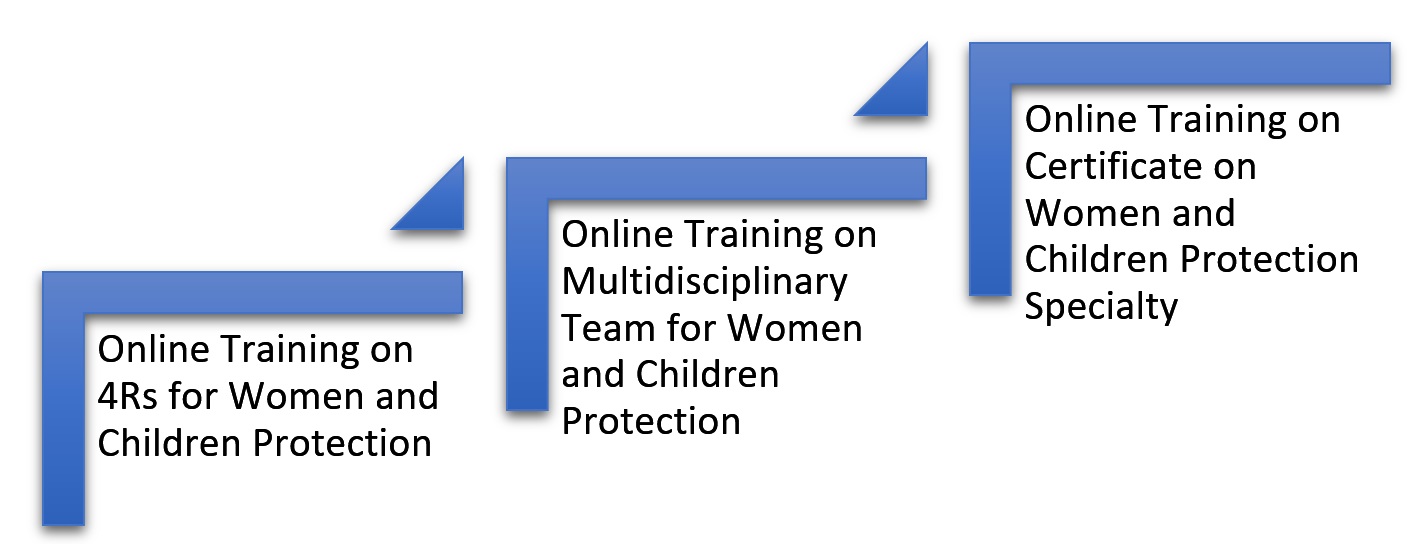
Central to all the operations of CPN for women and children protection is the capacitating of all members of society to recognize, record, report, and refer (4Rs) abused children and women. CPN has been conducting the 4Rs training for parents, school teachers, police officers, counsellors, physicians, social workers, lawyers, and other interested parties since 2008. This program evolved as the first step in the current ladderized program in women and children protection work. The other programs in the next ladders are the training in Multi-Disciplinary Team (MDT) approach, and the Certificate in Women and Children Protection Specialty (CWCPS). All these programs used to be a offered in a face-to-face (F2F) platform and participants coming from all groups were trained as a team. As COVID-19 continues to linger around the globe, CPN responds by migrating its ladderized program to an online platform.
TARGET PARTICIPANTS
Participants who satisfactorily complete the 4Rs, whose professional career tracks are related to management of domestic violence, and willing to pursue further educational qualifications may apply for the Online Multi-Disciplinary Team (MDT) Training. They may also seek the recommendation of their respective institutions to CPN for enrollment. Licensed professionals like physicians, social workers, guidance counsellors, and officers of the Philippine National Police (PNP) who complete the MDT Training will be awarded Certificates of Completion that they can present to the Continuing Professional Development (CPD) councils of the Professional Regulation Commission (PRC).
PROGRAM STRUCTURE
The ladder-type training programs of CPN are presented in the figure below. The 4Rs is a pre-requisite of the MDT which then serves as the gate pass to the WCPS. Participants can be enrolled as a participant upon formal application to CPN or receipt of their organization’s recommendation. They can complete the 4Rs at their convenient time.
PROGRAM OUTCOMES OF THE ONLINE TRAINING ON CERTIFICATE ON WOMEN AND CHILDREN PROTECTION SPECIALTY TRAINING (CWCPST)
The WCPST is composed of 3 modules. Participants are expected to finish all the online teaching-learning and assessment tasks in each of the module in two to three weeks. The three modules are equivalent to the educational or didactic component of the WCPST and can therefore be completed in one to two months. Participants who complete all the three online modules may be awarded their Certificates of Completion of Part 1 of the WCPST. After the didactics, participants are also expected to undergo at least a two-week practicum in a face-to-face (F2F) platform. Only after satisfactory completion of the two-week practicum will participants be awarded the Certificates of Completion of WCPST and practice as women and children protection specialists.
WCPST Program Outcomes
Licensed physicians, social workers, and officers of the Philippine National Police who have completed the CWCPS Training are expected to:
- Demonstrate effective communication skills both in oral and written forms, across all types of audiences and venues
- Given case scenarios of abuse in women and children, organizational, and management problems related to administering the WCPU:
- Competently gather adequate evidence with probative value
- Complete the required documentation of the clinical, legal, social, and / or organizational case/s
- Appropriately and judiciously use the MDT approach in handling violence against women and children (VAWC) cases
- Conduct case management effectively
- Comply with standard clinical, legal, and administrative regulations in establishing and maintaining quality of service of the WCPU
- Perform other pertinent roles outside their professions to serve the best interests of women and children from leadership to advocacy
CWCPST MODULE 1: MANAGING WOMEN AND CHILDREN ABUSE
WCPST Module 1 deals with the applications of basic principles, skills, and attitudes in managing women and children abuse cases as medical, social, and legal phenomena. Selected module videos and exercises used in MDT program will also be included to reinforce the mastery of concepts and skills acquisition of participants.
CWCPST Module 1 – Specific Outcomes
- Demonstrate effective communication skills
- Gather evidence competently to establish abuse as a case
- Appropriately use the MDT approach in VAWC cases
- Perform case management effectively
Module 1 Session 1 – Introduction
- What is trauma: “The Body Keeps the Score”
- CWCPST – M1V1: Introduction to WCPST
Module 1 Session 2 – Abuse in Women and Children (Required Session for all participants)
- Stand for Truth: Domestic violence ngayong ECQ, paano haharapin? by GMA Public Affairs
- WCPST – M1V2: Comprehensive Evaluation of Physical Abuse in Children
- WCPST – M1V3.1: Online Sexual Abuse and Exploitation of Children in the Philippines
- WCPST – M1V3.2: Understanding Online Sexual Exploitation of Children: Overview on Casework Challenges and Response
- WCPST – M1V3: Suggested Reference
- PDF: Online Sexual Exploitation of Children in the Philippines
- WCPST – M1V4.0: Evaluation and Management of Child Physical AbuseURL
- WCPST – M1V4.1: Abusive Head Trauma
- WCPST – M1V4.3: Medical Examination of the Abused Woman
Module 1 – Session 3 – Abuse in Women and Children (Suggested Review Session from MDT)
- MDT – M1V3: Long Term Effects of Child Maltreatment
- MDT – M1V4: Recognizing Abuse in Women
- MDT – M1V5: Recognizing Sexual Abuse in Women and Children
- MDT – M1V6: Recognizing Physical Abuse in Children
- MDT – M2V1: Crisis Intervention and Psychological First Aid/li>
- MDT – M2V2: Dynamics of Victimization
Module 1 – Session 4 – Bringing Women and Children Abuse Victims to Safety (Required Session for all participants)
- WCPST – M1V5: Violence Against Women and Children in Humanitarian Settings
- MDT – M3V2: Gender Responsive Case Management of Abused Women
- MDT – M3V3: Safety Assessment for Children
- MDT – M3V8: Medical Management: Diagnostics and Treatment
Module 1 – Session 5 – Bringing Women and Children Abuse Victims to Safety (Synchronous Session)
- PDF: WCPST 2nd Synchronous Session – Instructions and Cases File
- PDF: WCPST Batch – Groupings File
CWCPST MODULE 2: Advocating Against Women and Children Abuse
WCPST Module 2 deals with application of best practices in advocating for the protection of women and children from abuse. Participants will be expected to also demonstrate effective communication skills in handling women and children abuse cases for advocacy programs.
WCPST Module 2 learning outcomes
- Demonstrate effective communication skills
- Gather evidence competently to establish abuse
- Appropriately use the MDT approach in VAWC cases
- Perform case management effectively
- Competently manage women and children protection abuse victims in all stages of their cases from medical, legal, and social domains.
CWCPST MODULE 2 SESSION 1: Medico-Legal Competencies (Required Session for all participants)
- MDT M1V1 General Legal Framework
- WCPST M2V1 Forensic Interview
- Sample Video on Forensic Interview
- Additional References for Forensic Interview
- PDF: APSAC Forensic Interview of Children 2023
- PDF: Checklist for Interviewing – Questioning Children
- PDF: NCAC Forensic Interview Structure
- PDF: Office of Juvenile Justice
- PDF: Ten step investigative interview
- MDT – M2V3: Limits of Medico-legal Examination
- WCPST – M2V2: Investigating Abusive Head Trauma
- MDT – M2V6: Testifying in Court
- Suggested References for Module 2 Session 1
- Suggested Reference: World Health Organization. 2003. Guidelines for medico-legal care for victims of sexual violence.
- Open Educational Resources – Link: Carole Jenny, MD, MBA, James E. Crawford-Jakubiak, MD, and The Committee on Child Abuse and Neglect. The Evaluation of Children in the Primary Care Setting When Sexual Abuse Is Suspected. American Academy of Pediatrics
- PDF: The Evaluation of Children in the Primary Care Setting When Sexual Abuse Is Suspected
- PDF: WHO Guideline
CWCPST – MODULE 2 SESSION 2: Professional Competencies for Police Officers (Required Session for police officers)
- WCPST – M2V3: The New PNP Manual
- WCPST – M2V3: Overview of Online Sexual Abuse and Exploitation of Children (OSAEC)
- MDT – M3V9: How to Prepare a Sworn Statement
- MDT – M3V10: Crime Scene Investigation and Evidence
- MDT – M3V11: Search Warrants and Warrants of Arrest
- WCPST – M2V4: Issues/Concerns Regarding Filing of Complaints by Law Enforcers
- Suggested References for Module 2 Session 2 – Women And Children Protection Desk Investigator’s Manual (2021) (PDF)
CWCPST – MODULE 2 SESSION 3: Advocating for the Victims and Families of Domestic Violence (Required Session for all participants)
- WCPST – M2V5: Family Psycho-education
- WCPST – M2V6: Trauma Informed Care and Self Care
- WCPST – M2V7: Psychoeducation and Coping of Individual Child
- WCPST – M2V7.1: Psychological Screening Tools
- Template Forms of Psychological Screening Tools
- PDF: Columbia Suicide Sevrity Rating Scale (CSSRS) Screen Version
- PDF: Patient Health Questionnaire – 9 (Modified)
- PDF: Psychological Trauma Assessment Questionnaire (PTAQ)
CWCPST – MODULE 2 SESSION 4: Professional Competencies for Physicians, Social Workers and Police Officers (Required Sessions for all participants)
- MDT – M2V4: Multidisciplinary Evaluation and Management of Child Abuse Cases
- MDT – M2V5: Multidisciplinary Case Conference on Child Abuse
- Reference for Module 2 Session 4 – Protocol for Case Management of Child Victims of Abuse, Neglect, and Exploitation (PDF)
- M3V7 – Charting and the Medico-Legal Form (Required for Physicians)
- M3V14 – Social Case Study Report (Required for Social Workers)
- Intake Form: Case of Princess
- Interview Form: Case of Princess
- Intake form: Case of Carlo
- Interview Form: Case of Carlo
- Intake Form: Case of Bennie
- Interview Form: Case of Bennie
- Intake Form: Case of Gina and Mai
- Interview Form: Case of Gina and Mai
CWCPST – MODULE 2 SESSION 5: Organization and Advocacy Competencies (Required Session for all participants)
- WCPST – M2V8: Media and the Frontliner
- WCPST – M2V9: Advocacy Action Plan
- Suggested References for Advocacy Plan
- PDF: Advocacy Guide
- PDF: Advocacy Toolkit Part 1
- PDF: Advocacy Toolkit Part 2
- PDF: Advocacy Toolkit Part 3
- PDF: Advocacy Toolkit Part 4
- PDF: Preventing Child Abuse and Neglect
Certificate on Women and Children Protection Specialty (CWCPST)
The last step in the ladder is the Women and Children Protection Specialty Training. Those intending to establish Women and Children Protection Units need to complete this training.
Eligible trainees:
- A team that has completed the MDT Training.
Requirements:
- Signed Memorandum of Agreement with LGU-based hospital
- Protected time
- Access to strong internet connectivity
Phase 1: Online
Training Course:
- Three (3) online modules
- Two (2) months to complete
Method:
- Both asynchronous and scheduled synchronous sessions
Phase 2: 2-week practicum
Training course: A 2-week onsite practicum can be completed at any of the following training centers:
- Philippine General Hospital – Child Protection Unit
- Baguio General Hospital and Medical Center – WCPU, Baguio City
- Ilocos Training and Regional Medical Center – WCPU, La Union
- Vicente Sotto Memorial Medical Center – WCPU, Cebu City
- Gov. Celestino Gallares Memorial Hospital, Bohol
- Western Visayas Medical Center, Iloilo City
- Southern Philippines Medical Center – WCPU, Davao City
- Davao Regional Medical Center – WCPU, Tagum City, Davao del Norte
- Northern Mindanao Medical Center – WCPU, Cagayan de Oro City
Navigating the Women and Children Protection Online Learning (WCPOL)
The Online Training on the 4Rs, MDT, and CWCPS is a project of the CPN together with its partner agencies namely the United Nations Population Fund (UNFPA), University of the Philippines Manila through the National Teacher Training Center for the Health Professions (NTTCHP) and the Information Management Service (IMS), and the International Container Terminal Services, Foundation, Inc (ICTSI). Resource persons include faculty members and practitioners in Pediatrics, Social Work, Law, Psychiatry, Psychology, and other related fields directly handling children and women who are victims of all forms of domestic violence. Working together with CPN in this training are various government, non-government, and civic organizations that make them ready resource and contacts for referrals and appropriate actions that participants may need to consult in the course of the training.